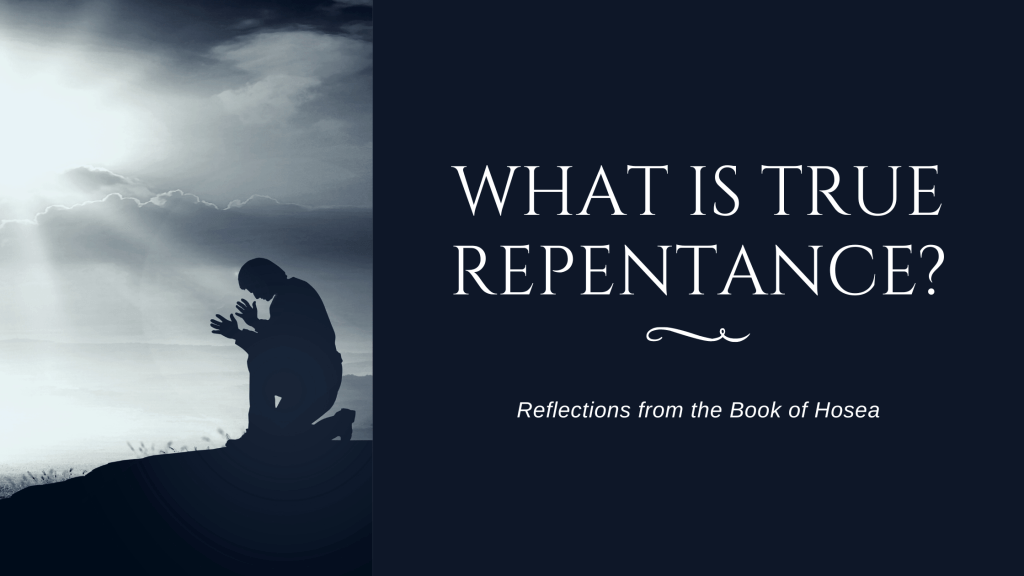


Reflections from the book of Hosea.
By: Mike D. Hollis
In Gilbert and Sullivan’s classic musical, The Pirates of Penzance, there is this great scene where a group of singing maidens implore the local police force to go out and fight a band of pirates. They sing: “Go, ye heroes, go to glory, though you die in combat gory, te shall live in song and story. Go to immortality! Go to death, and go to slaughter; die, and every Cornish daughter, with her tears your grave shall water. Go, ye heroes, go and die!” Now the policemen are on the timid side, and they are not so excited to receive this rather ominous call. They express their appreciation for the ladies’ affection and sentiment, but they would rather stay and sing than go and die.
But the maidens continue to implore them and eventually, the policemen begin to sing and march, “We go, we go! We go, we go, we go!” But then, quite humorously, they don’t go. They simply march around in circles singing. As they sing and march, with the maidens joining them, the maidens’ father can’t help but notice that no one is going anywhere. They march and sing, “We go! We go!”, and the father keeps interjecting, “Yes, but you don’t go.” “We go! We go!”, “But you are still here.” It’s all very humorous. The Pirates of Penzance is a classic comedy of the absurd, with each cast of characters attempting to outdo each other in sheer ridiculousness.
As I read through Hosea, this scene kept coming to mind. In many ways, the song of Israel throughout her history bears a striking resemblance with Gilbert and Sullivan’s police force and the winsome critique of the maidens’ father. Israel proclaimed, “We go! We go!” Yet, God interjects, “But you don’t go!” Of course, one big difference between The Pirates of Penzance and the book of Hosea is that Hosea is not meant to be a comedy of the abused, it’s a spiritual tragedy of the highest order.
Hosea is not meant to be a comedy of the abused,
it’s a spiritual tragedy of the highest order.
We need to consider this tragedy briefly and what we might learn from it so that we do not follow in the same tragic footsteps. We want to consider what true repentance is in two movements. First, we need to recognize the signs of false repentance and, second, we need to respond by moving toward true repentance.
Recognize the signs of false repentance.
Hosea 6 begins with Israel’s intent to repent. It’s a striking invitation. The people make a public announcement regarding their move to return. This move is prompted by God’s announcement of impending judgment for Israel’s spiritual adultery back in chapters 4-5. The people say, “Come, let us return to the Lord…” (6:1a ESV).1 They even declared the motivating factor which would lead them to return to the Lord – “…for he has torn us, that he may heal us; he has struck us down, and he will bind us up.” (6:1b).
Israel was right. God tore her apart and struck her down to heal and bind up. God never disciplines His people without first warning His people. God also never disciplines His people with no purpose in mind – the purpose always being repentance and restoration (Heb. 12:6). The people declare they are returning to the Lord, hoping that “After two days he will revive us; on the third day he will raise us up, that we may live before him.” (6:2).
They go on to declare that they will know the Lord, and such knowledge would surely mean God would come to heal and bind up their wounds, just as the sun rises and the rain falls. So, they say to each other, “Let us press on to know the Lord.” It sounds like the people have listened to the prior prophecy. Back in Hosea 4, God declared that His people were destroyed for “lack of knowledge.” So, the people give a double emphasis to knowing the Lord in Hosea 6:3 – “Let us know; let us press on to know the Lord.”
But there is a problem. Israel’s repentance is false repentance; it’s not genuine. No matter how good words may sound on the surface, God sees our hearts. In Hosea 6:4-6, God issued a stern rebuke against Israel’s words. God’s complaint against Israel’s return is that it is a return without repentance. Israel wanted revival and restoration, but without repentance. But the only vehicle toward revival and restoration is repentance. Because Israel had a faulty view of repentance, she offered to God a false repentance.
What are the signs of false repentance?
1. Repentance is more religious vocabulary.
Israel’s words seem to be appropriate but something crucial is missing. There is no acknowledgment or admission of sin. There is no confession of guilt, which is exactly what God wanted before He would return to them (cf. Hosea 5:15). Israel spoke a lot of religious vocabulary, a lot of spiritual language, a lot of “churchy” mumbo-jumbo, but it’s not true repentance. Her words are empty, void, and meaningless (cf. Hos. 6:7; 7:1-2).
Israel’s profession did not match her practice. Israel believed her sin was hidden out of sight, that no one knew the truth about her actions, but they were not hidden from God. God said, “I remember all their evil…their deeds…are before my face” (7:1-2). Further, God himself declared Israel’s repentance was false, “They return, but not upward…” (7:16). Genuine repentance is directed upward toward God, but Israel’s repentance was directed outward and consequently, downward, away from God. She used the right vocabulary but stripped repentance from its meaning.
2. Repentance is more than mental assent.
Repentance is more than knowing the right information. Israel’s expressed desire was to “know the Lord”, but she only wanted to know the Lord superficially to benefit from His divine aid. Israel only wanted information about God. She cared nothing about being transformed by Him.
If we are not careful, we will confuse true repentance with just knowing all the right doctrines, reciting all the right information, and having the right understanding of sin. But do not make the mistake of saying that you are repentant simply because you can recite Scripture or have served in the church for years or even have a degree from a Bible college or seminary. Your mind can approve of information without your heart accepting transformation.
Your mind can approve of information
without your heart accepting transformation.
The prince of preachers, Charles Spurgeon, once said: “I may know all the doctrines of the Bible, but unless I know Christ, there is not one of them that can save me.”2 Repentance is more than intellectual assent; it’s more than knowledge. It is not just knowing the wages of sin is death (Rom. 6:23) that marks true repentance, but knowing the wages of sin is death and knowing your need for Christ’s cleansing from sin that only comes through repentance and faith in Christ.
3. Repentance is more than intense feelings.
According to God, Israel’s cry was emotional, but it was not believable. Her sorrow was not over sin, but over lost amenities (7:14). Israel was so intoxicated with the world, literally speaking, that she cried and grieved over not having alcohol, but not over her sin. There’s certainly emotion, but it is entirely misplaced.
Let me be clear: repentance does invoke and involve our emotions. But if all we ever do is feel a certain way about sin without ever answering the biblical call to repent of sin, we give false repentance. God’s Word does not only prompt the right feeling about our sin, but the right response toward our sin (Ps. 51:17; 2 Cor. 7:10).
We need to let the weight of what we have done against God because of sin and the depth of what God has done for us through Jesus Christ stir our emotions. But true repentance must move beyond feelings to actions.
Respond by moving toward true repentance.
Because of the dangers of false repentance, we need to know the definition and direction of true repentance. Simply, repentance is turning from sin and turning to God in faith. Repentance and faith, you might say, are two sides of the same coin – you cannot have one without the other. In repentance, you turn from self and sin. In faith, you turn to God and cast yourself upon His mercy and grace given through Jesus Christ. Both are required.
True repentance is not turning from self and sin and turning to righteousness. That leads to confidence in yourself. True repentance is turning from self and sin and turning to Jesus Christ, placing your confidence in what He has done for you through His sinless life and sacrificial death. As Robert Murray M’Cheyne put it, “For every look at yourself, take ten looks at Christ.”3 May this be our pursuit in every area of our lives. Turn from sin and self; turn to Christ in faith. We are great sinners, but Christ is a great Savior!
May we not merely sing “We go! We go!” and walk about in circles, never actually going. Let us finally return to and continually remain with the Lord.
- All Scripture quotations are from the English Standard Version (Wheaton: Crossway, 2011) unless otherwise indicated.
- Charles H. Spurgeon, “Knowing and Believing,” a sermon published on Thursday, December 5, 1912. Delivered by C. H. Spurgeon, at the Metropolitan Tabernacle, Newington, on Lord’s-day evening, September 30, 1866. https://ccel.org/ccel/spurgeon/sermons58/sermons58.xlix.html
- Robert Murray M’Cheyne, Memoir and Remains of the Rev. Robert Murray M’Cheyne, Ed. Andrew A. Bonar (Edinburgh: Banner of Truth, 1844/1966), 293.

